

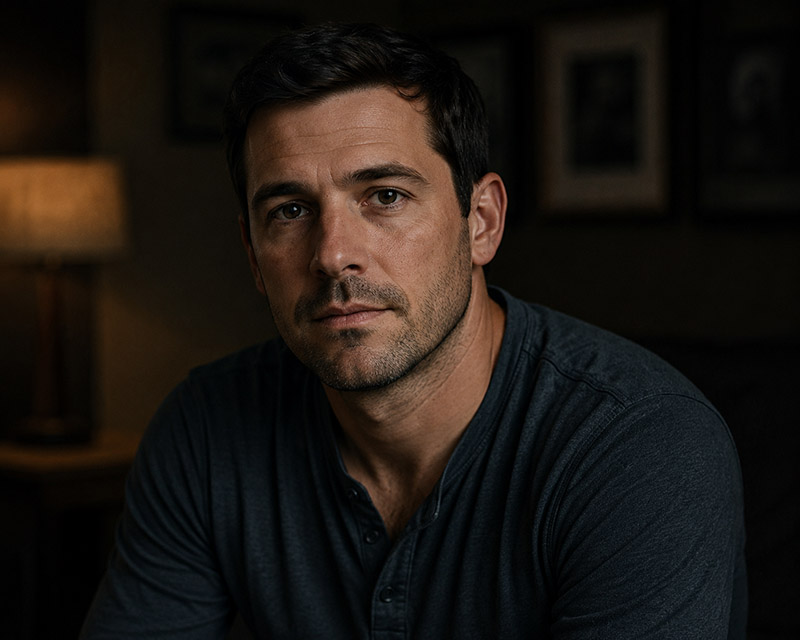




Chase

CHANDLER

AWAKE

What if God wasn’t trying to fix your life…

but wake you up inside it?

A respected husband, father, and provider begins waking every night at 3:07 AM — and finds himself drawn to a quiet pasture, a strange young man, and a question he can no longer outrun.

Follow the journey to publication.

AWAKE is currently being prepared for publication and agent submission. Join the early reader list for updates, excerpts, behind-the-scenes notes, and release information.

Follow the journey to publication.​

AWAKE is currently being prepared for publication and agent submission. Join the early reader list for updates, excerpts, behind-the-scenes notes, and release information.

David had built a life that worked.

Until it didn't.

The man everyone counts on has learned how to disappear beneath the weight of being needed.

At work, he has answers.
At home, he carries the weight.
At church, he knows the language of faith.

He solves what can be solved. Provides what can be provided. Keeps his voice even and his family sheltered from the tremors moving underneath him.

Until a corporate email arrives with no accusation, no cruelty — only the quiet question of how much of him could be documented, transferred, and absorbed.

Then the waking begins.

Every night.

3:07 AM.

Not a nightmare.
Not an attack.

An appointment.

For much of the novel, David believes he is the one carrying the house.

Then Jenn speaks.

And the story turns.

Because fear does not stay hidden in the man who carries it. It enters rooms. It teaches children caution. It gives silence a place at the table.

Some words stay with you.

What if I trusted fully... and God didn't catch me?

Fear only needed somewhere to land.

Responsibility is a useful word. It can hide a lot.

Pressure does not stay where you put it.

Some people just start spinning faster and call it prayer.

I could make almost anything sound righteous.

We were good Christian people. We fought the quiet way.

If your peace needs everything to hold together, it isn’t peace.

What if I trusted fully... and God didn't catch me?

Fear only needed somewhere to land.

Responsibility is a useful word. It can hide a lot.

Pressure does not stay where you put it.​

Some people just start spinning faster and call it prayer.​

If your peace needs everything to hold together, it isn’t peace.​

A story for anyone who has mistaken responsibility for identity.

AWAKE is upmarket Christian fiction about anxiety, control, provision, sonship, marriage, pressure, and the quiet mercy of being exposed before being healed.

It is not a story about escaping the fire.

It is a story about discovering who you are while still standing in it.

Identity in Christ

Marriage & Family

Anxiety & Pressure

Provision & Trust

Sonship

Suffering & Hope

Identity in Christ

Marriage & Family

Anxiety & Pressure

Provision & Trust

Sonship

Suffering & Hope

The people who shape the journey.

David

A husband, father, and corporate problem-solver whose usefulness has quietly become his identity.

Jenn

David’s wife, whose own voice becomes one of the novel’s strongest turns — revealing what pressure has cost their home.

The Young Man

A quiet figure in a pasture who gives away what he has, carries no cash, and lives as if God is actually enough.

Ruth

An old woman at the fence with one simple instruction David cannot ignore:
Take it home.

Follow the journey to publication.​

AWAKE is currently being prepared for publication and agent submission. Join the early reader list for updates, excerpts, behind-the-scenes notes, and release information.

Follow the journey to publication.

AWAKE is currently being prepared for publication and agent submission. Join the early reader list for updates, excerpts, behind-the-scenes notes, and release information.

For readers drawn to spiritually serious fiction with emotional honesty.

AWAKE may appeal to readers who enjoy reflective Christian fiction, emotionally honest family stories, and novels where spiritual transformation unfolds through ordinary life rather than easy answers.

Prologue

The Field

The first time I saw him, I was in no shape to be stopping anywhere.

My hands were locked on the steering wheel. My jaw ached from clenching it. I had missed a turn ten minutes back, then another after that, and by then I was no longer pretending I had somewhere specific to be. My phone kept lighting up on the console with the same unread email I had already opened twice and still could not answer.

Workflow Coverage Documentation

Nothing urgent in the wording. Nothing dramatic. Just one more message asking how much of my work could be handed to somebody else if it had to be.

That combination has a way of putting a man on roads he does not remember choosing.

The pavement narrowed to two tired lanes running between fields gone a little wild and a line of pines standing dark and still beyond them. Late spring had filled everything in. Grass thick in the ditches. White blooms I could not name. Honeysuckle somewhere in the heat-soft air. The kind of day that looked alive and overgrown at the same time, already tipping toward summer.

I pulled over because I needed to do something besides keep driving.

For a moment I sat there with the engine off, listening to it tick as it cooled.

Then I saw the goats.

At first they looked like driftwood scattered through the grass. Then one lifted its head, another turned, and the whole field came into focus. A small herd wandered in no hurry at all, cropping at the weeds and meandering through the pasture like the day belonged to them.

And in the middle of them sat a man on an overturned bucket.

He was near the edge of a garden that looked more hopeful than finished. It had the look of something built to be useful, not pretty—patched together, still in progress, but alive.

Nothing matched. It looked used.

He was not doing much of anything. That was the part that caught me.

He was not driving the goats off. Not fixing the fence. Not even watching them closely. One pressed against his leg. Another nosed his shoulder. A third made an awkward, determined attempt to climb onto the bucket beside him.

He let it try for longer than I would have.

The bucket shifted crooked in the dirt when the little goat leaned harder, and he steadied it with his foot without looking down. Then he scratched behind its ear, absently, the way a person does when he is used to being leaned on.

I should have driven on.

Instead I sat there watching until he stood, wiped his hands on his shorts, and crossed toward the garden. The goats shifted with him as if tugged by an invisible cord. Not trained. Not frantic. Just drawn.

Before I had fully decided to, I was out of the truck and pushing open the gate.

It creaked. A few goats looked up. Most did not bother.

He turned toward me.

Early twenties, maybe. Hair cut uneven like he had done it with a bathroom mirror and no patience. A scraggly beard ran ahead of his age, thin through the mustache and fuller along the jaw, like he had never once considered whether it suited him. Plain white T-shirt. Faded shorts. Worn Crocs. Dirt worked into his hands. Grass stuck to one knee.

Nothing about him should have made me pause.

But his eyes did.

They were steady in a way that felt almost rude.

“Hey,” he said.

“Hey.”

One of the goats wandered over and sniffed my shoe.

“You don’t have food, do you?”

“No.”

“Good.”

I looked at him. “Why good?”

“Then they’ll leave you alone.”

Almost on cue, the goat lost interest and drifted off.

I rested a hand on the fence post, still not sure why I was there.

“This your place?”

He glanced around the pasture, the garden, the goats, like he was checking the edges of the question.

“Sort of.”

“What does that mean?”

He bent and tugged a weed from the soil. The top came free in his hand while the root held fast. He looked at it, crouched lower, and dug the rest out with two dirty fingers before tossing it aside.

“It means none of it’s mine.”

He straightened. “I tend to what I’m given.”

He said it the way a man says rain is coming. No ceremony in it. No glance to see what I did with it.

I waited for the explanation that usually follows a sentence like that.

None came.

He scratched lightly at the side of his jaw, as if deciding whether anything else needed saying. Then he looked at me once and said, “So what’s wrong?”

I gave a short laugh. “Nothing.”

A small grin touched one corner of his mouth.

“That’s usually not true when somebody pulls over on a back road to watch goats.”

I could have left then.

Instead I heard myself say, “My life’s kind of falling apart.”

He nodded once, like I had told him it might storm later.

“That happens.”

I stared at him. “That’s it?”

He picked up a dented watering can and tipped it slowly at the base of a plant.

“Let me ask you something.”

I said nothing.

“If everything settled down today, all the things you’re carrying, all the things you’re trying to keep from breaking, what would that give you?”

The answer came too fast. “Peace.”

He nodded as if he had expected it.

“For how long?”

I looked at him. “What?”

He set the can down. “An hour? A day? Till the next thing goes sideways?”

I felt the irritation rise before I could hide it, because I knew exactly what he meant and did not like hearing it out loud.

He looked at me then, not hard, not soft. Just direct.

“If your peace needs everything to hold together,” he said, “it isn’t peace.”

I folded my arms. “Then where does it come from?”

He held my eyes a second longer than was comfortable.

“Knowing who you are.”

He turned and went on with what he had been doing, as if his part of the conversation was over.

Around him, the goats eased back into their wandering. The garden stood there in its lopsided rows. A breeze moved through the trees at the back of the pasture and stirred the tall grass.

I stood there a moment longer, a grown man with six mouths at home and a mind full of numbers, staring at someone who looked like he had stepped clean out of every system I trusted.

I did not know his name. I did not know what had brought him to that field, or what kind of life could make a man that calm. For all I knew, he was running from something. Men did not usually end up alone with goats and a garden without a story behind them. I only knew the peace I had just seen did not fit the world I lived in.

And I did not trust it.

Chapter 1

3:07 AM

The clock beside my bed read 3:07 AM.

Again.

My heart was already pounding when I opened my eyes, as if my body had gotten there ahead of me and was waiting in the dark. My stomach carried that hollow drop of dread, like stepping off a curb you didn’t see.

I lay still for a moment, trying to out-stubborn whatever this was.

That had never worked before, but at 3:07 a man will try familiar failures before admitting he has no new ideas.

My mind was already moving.

Mortgage. Taxes. Clients. Insurance. Health. Kids.

The email from yesterday. The one from last week. The AC unit making that noise again behind the office.

The thoughts moved quickly, like a practiced hand flipping cards.

My mind did not wait for proof.

Fear only needed somewhere to land.

I rolled onto my back and stared at the ceiling, counting breaths like a man counting coins he already knew would not be enough.

In.

Hold.

Out.

That was what the internet said to do.

It didn’t help.

I reached toward the nightstand for my phone, then remembered I had started leaving it in the kitchen at night. I called it discipline. A boundary. Something spiritual.

Really it was because at 3:07 in the morning the glow of information felt like gasoline.

A thousand little ways to remember I wasn’t in charge.

My wife lay next to me, her breathing soft and rhythmic.

I envied her.

I sat up carefully and stepped into the hall.

The house was still. Even the floorboards seemed tired. I paused outside my sons’ room.

Four of them. Two bunk beds. All in the same room. They wouldn’t have it any other way.

Young men now, mostly. But in my mind they were still the boys who once filled this house with action figures and wrestling matches and loud declarations about who got to be Batman.

Their door was cracked open. The nightlight cast a warm stripe across the carpet. In the corner, a box fan hummed softly.

The three oldest were wrapped in their sheets like small cocoons.

But Shepherd was sprawled across his mattress like a fallen starfish, completely surrendered to sleep.

I stood there and watched them breathe.

In moments like that, they looked untouched by the world. No bills. No deadlines. No thinly worded email asking how much of my work could be absorbed if it had to be.

Some part of me still believed it was my job to keep them that way. Stay ahead, and the people you love never have to feel what you feel at three in the morning, lying awake with your heart pounding in the dark.

I leaned against the hallway wall and listened to the fan fill the room.

I had spent most of my adult life becoming the kind of man people trusted.

Men had called me before signing leases, before hiring staff, before risking money they could not afford to lose. I knew how to sound calm when numbers were moving. And I liked watching others win. I liked being the guy who could say, Here’s what I did. Here’s how you do it too.

None of it had ever made my chest feel calm at 3:07 AM.

Younger, I woke afraid I would not have enough.

Older, afraid I would lose what I had built.

Fear is clever.

I walked into the kitchen and poured a glass of water. The stove clock glowed. The coffee maker blinked green. My hands shook slightly. Not enough for anyone to notice in daylight. Enough for me to notice now.

I looked up and caught my reflection in the black window over the sink—older than I expected, eyes tired, shoulders carrying something invisible.

I had been a Christian most of my life.

Not casually. I believed God was real. I believed Scripture was true. I had stood in front of crowds of people for years and told them He was faithful, that peace was not circumstantial, that fear did not get the final word.

I believed those things in daylight.

At 3:07, my body made a better argument.

I set the glass down and leaned forward, palms against the cool granite.

A memory surfaced.

Years earlier, in the middle of what should have been my most successful season, my wife and I started seeing a Christian psychologist named Lou. From the outside, life looked solid—successful. Inside, I was waking up like this.

That was the deal success made with me. It gave me what I asked for, then demanded I keep feeding it.

Lou gave me something practical.

“Picture the problem,” he said. “Now put it in a small wooden box. Close the lid. Slide it under the bed. Deal with it in the morning.”

It sounded strange. It also worked.

For a while.

At 3:07 I would picture the box. Small. Wooden. Hinged lid. I would place the business inside it. Then payroll. Then contracts. Then whatever else was clawing at my mind. I would shut the lid and slide it away.

And for a little while, my thoughts would quiet.

Eventually the boxes multiplied.

Soon the space under the bed was crowded with imaginary containers full of everything that might go wrong in my life.

I felt the humiliation of that settle in. The constant assumption that if anything was going to stay standing, I needed to be the one bracing it.

I rinsed the glass.

The sound of water hitting the basin was loud in the silence.

My thoughts were louder.

Fix the business.

Fix the finances.

Fix the schedule.

Fix the health.

Fix the relationships.

Fix everything, and then you can rest.

But rest never came.

I tried again.

In.

Hold.

Out.

I turned off the faucet and stood there.

My eyes drifted to the stove clock again.

3:07.

Still.

As if time itself was waiting to see what I would do.

And then, the thought was handed back to me. The field. The goats. The garden. The young man with dirt on his hands and no visible urgency anywhere in him.

Peace comes from knowing who you are.

I still did not like the sentence.

Mostly because I still did not have a better one.

I stood there a little longer, staring at the faint reflection of myself in the glass, until the thought came clear enough to name.

I was going back.

Not because I believed him.

Because if he was wrong, I wanted to know where it broke.

And if he was right, I needed to know what it would cost.

Chapter 3

Into the Woods

The air changed the moment we stepped beneath the trees.

Out in the pasture the light had been broad and open, spread across the grass like it meant to stay awhile. Under the canopy, everything narrowed. Sunlight came down in quieter pieces. The ground softened beneath our feet with old leaves and pine straw. The smell changed too—cooler, earthier, touched with sap and shade.

The goats moved with more purpose here.

A few pushed ahead through the brush. Others stayed close to the young man, brushing his legs as they walked, unhurried and sure, like they had made this trip often enough to trust what waited at the end of it.

He didn’t call them.

He didn’t shake feed in a bucket.

He didn’t do anything I would have recognized as management.

He just walked.

And they followed him as if that were enough.

No visible system. No urgency. No tool in his hand but attention.

I was still trying to decide whether that meant wisdom or immaturity when he slowed.

It was slight enough I might have missed it if I hadn’t already been watching him too closely. His eyes shifted past the front of the herd toward the back. One of the smaller does was lagging a little. Not much. Enough. Every few steps she favored one front hoof, then recovered before the limp could fully show itself.

He changed direction at once.

“What is it?” I asked.

“She’s sore.”

That was all.

He moved toward her without hurrying. The doe tried to slip past, but he reached one hand to her neck and the other under her chest and caught her with practiced ease. She twisted once, offended more than frightened.

Then he looked at me.

“Can you hold her?”

I nodded. “Sure.”

He shifted her toward me, and I took hold of her the way I would have taken hold of anything that needed holding—with the vague confidence that strength ought to be enough.

It wasn’t.

The goat bucked harder than I expected. Not wildly. Just with a quick, wiry force that turned her whole body into motion. Her shoulder knocked my forearm. One hoof scraped bark loose from a root. I tightened my grip and nearly lost her anyway.

His mouth moved like he might have smiled.

“Here,” he said. “Not like that.”

He stepped in and moved one of my hands lower, near the front of her chest.

“Turn her a little. If she gets straight, she’ll push through you.”

I adjusted. Right away I felt what I had missed. More weight. Better leverage. The animal went from slippery nuisance to compact, determined thing full of muscle and opinion.

“Easy,” I muttered.

I wasn’t sure whether I meant her or myself.

He crouched and lifted the sore hoof. He turned it toward the slant of light coming through the branches and ran his thumb along the outer edge, then into the softer place near the center.

“There,” he said.

I leaned awkwardly, trying not to loosen my grip.

At first I didn’t see it. Then I did. Something dark and narrow buried at an angle.

“What is that?”

“Pear thorn.”

“From those trees?”

He nodded once. “Wild ones.”

The doe jerked when he touched the spot. I tightened again.

“She’s stronger than she looks.”

“They usually are.”

He said it like fact, not lesson.

He braced the hoof lightly against his knee, pinched the thorn between his fingernails, and pulled. The doe kicked once. I shifted with her and heard him say, calm and firm,

“Hold her.”

I did.

The thorn came free in his fingers—longer than I expected, pale at one end, dark at the other, wickedly thin.

He tossed it aside and ran his thumb across the hoof once more, checking for anything left behind. Satisfied, he set the foot down and stood.

“All right.”

I loosened my grip carefully. The doe pulled free, took two quick steps, then a third. She paused as if surprised by the difference, then trotted after the others with only the faintest trace of the limp still clinging to her stride.

I straightened more slowly than I meant to.

He brushed the dirt from his hands.

“You saw that from all the way back there?”

He looked toward the herd. “She was off.”

Ahead of us, the goats were already spreading toward a patch of low branches near the edge of the trees. He nodded that way and started walking again.

I stayed where I was a second, rubbing my palm against my jeans where the doe’s weight had pressed into it.

Then I followed.

And when I did, it was with the uncomfortable awareness that I had come into the woods expecting to observe a life.

Instead I had already had to put my hands on it.

The goats pushed deeper beneath the trees, weaving through brush and saplings with more purpose than they had shown out in the pasture. The young man stopped beside a young maple and reached for a low branch. He let it go almost at once, studied the tree a second, then chose another limb farther in and bent that one down instead.

Goats crowded in at once.

They rose into the leaves with quick little jerks of their heads, stripping them fast. One stood on its hind legs for a better reach. Another shoved in from the side as if convinced patience was for lesser creatures.

I laughed under my breath.

“So this is what they were waiting for.”

“Partly.”

He bent another branch and nodded toward me.

“Here.”

I took it before I had time to decide whether I wanted to.

The moment I lowered it, three goats surged in. Their mouths moved faster than I expected, tugging leaves free in quick snaps. One stretched nearly upright to reach the end.

“Whoa,” I said.

The young man smiled a little.

“They like what’s higher.”

When the branch was bare, I let it go too soon and it sprang out of my hand.

He had already moved on to the next tree.

“They won’t eat much off the ground if they don’t have to,” he said.

“Why not?”

“That’s not what they’re made for.”

He nodded toward the branches overhead.

“They’re browsers.”

I watched one stretch up again, balancing awkwardly on its hind legs to reach a cluster just above it.

For a while we worked like that. Bend. Hold. Strip. Move.

It was simple work, but not careless work. He seemed to know which limbs would give without breaking, which patches the goats would clear fastest, which ones still needed help reaching. Nothing about it was hurried. Nothing about it was random.

That bothered me more than if he had been sloppy. Competence is easier to respect than dismiss.

“You do this every day?” I asked.

“Most days.”

“Seems like a lot of work.”

“It is.”

I looked around at the trees, the brush, the goats working at the leaves.

“You could make it easier.”

He glanced at me and bent another branch down while a smaller goat squeezed underneath a larger one.

“How?”

I gestured around us. “Cut some earlier. Stack it near the pasture. Feed them there instead of doing this one limb at a time.”

He thought about it.

“Probably would.”

He handed me another branch.

“Hold that.”

I took it, mildly annoyed by how quickly I obeyed.

The goats surged in again.

“I’m serious,” I said. “You’d save time. Energy.”

He broke off a dead twig from the limb in his hand, looked at the uneven end, and let it fall.

“Easier for who?”

I watched the goats strip my branch bare. “Both, I’d think.”

“Maybe.”

I shifted my grip. “You don’t think efficiency matters?”

“I think it matters.”

He bent the branch a little lower for one of the smaller does.

“Just not most.”

I let my branch go. It snapped back overhead.

“What matters most, then?”

He scratched lightly along the neck of the doe we had stopped for earlier. She had worked her way back beside him and was eating without the hitch in her step.

“This way I can see them.”

He nodded toward the herd.

“If I just throw it to them, they’ll eat. But this way I notice things. Who’s getting pushed off. Who’s slower than usual. Who’s not eating like they should. If one’s coat changes. If one’s sore.”

His eyes flicked once toward the doe’s front hoof, then back to the branches.

“They’d get by either way,” he said. “But they do better when they stay near.”

I looked at the goats instead of him.

I had the uncomfortable feeling he meant more than goats.

The woods had gone quiet around us in that settled way places do when a man finally stops bringing all of himself in at once. Leaves stirred overhead. Hooves shifted in the brush. Branches snapped lightly under hungry mouths.

We moved a little farther.

He reached for a low oak limb. The bark slid under his palm and the branch jumped loose before he had it. He caught it again, lower this time, and drew it down into place without a word.

No joke.

No explanation.

Just adjustment.

For some reason that told me more than if he had done it cleanly.

Most people make a little ceremony out of mistakes. They cover them. Smooth them over. He didn’t seem interested in any of that.

He just corrected and kept going.

That helped.

Not enough to settle me. Enough to keep him from drifting into some category I couldn’t stand.

“You ever think about doing more?” I asked.

He looked over.

“More what?”

“More than this.”

He glanced around the trees, the goats, the branches stripped bare and springing back into place.

His answer took long enough that I thought he might actually be considering the question.

“Sometimes people say that.”

“That’s not an answer.”

“It’s the one I’ve got.”

I let out a breath through my nose.

“You know what I mean. You’re young. You work hard. You’ve got good instincts. You could build something. A business. A real operation. Something that goes somewhere.”

He lowered the branch another inch so a smaller goat could reach.

“And this doesn’t go anywhere?”

I opened my mouth, then shut it again.

Because saying what I meant would have sounded uglier out loud than it had in my head.

He spared me.

“Maybe I just mean somewhere different than you do.”

That should have struck me as naive.

It didn’t.

I kept trying to put him somewhere in my mind where he would stay. He kept moving.

The trees had begun to thin ahead of us. Warmer light showed through in patches where the pasture waited on the other side.

The goats sensed the edge before I did. A few pushed forward, movement sharpening.

He let the branch rise and dusted his hands together.

For a moment neither of us said anything.

I looked at the herd. At the doe moving without pain. At the leaves stripped clean from branches I would have called inconvenient an hour earlier. At the young man standing there in worn Crocs and dirt-streaked shorts, not looking finished or polished or especially impressive. Just present. Just aware.

I had gone into the woods expecting to find looseness dressed up as peace.

Instead I found attention.

I still believed his world was too small.

I was just no longer certain he was.

Chapter 18

Buttons

I woke before the alarm.

The house was dark and quiet.

Beside me, my wife breathed soft and sure.

That steadiness did something to me.

Not comfort.

Conviction.

Ruth’s words were still in me.

Take it home.

Simple words.

Small enough to survive a grocery store aisle.

Heavy enough to follow a man into his own kitchen.

I slipped out of bed and went to the sink. The stove clock glowed faint green. Later than 3:07. Close enough to irritate me anyway.

I drank half a glass of water without tasting it and stood there with my palm against the counter like a man waiting for instructions.

Then I did what I always did when I felt cornered.

I prayed.

But not well.

“God . . . please.”

Silence.

Then the next layer.

“I’m sorry.”

Then the thing under that.

“I can’t do this.”

My heart knocked too hard for a house that was perfectly safe.

“God . . . I need You to fix this.”

And the moment the words left my mouth, I knew what I meant by this.

Not my heart.

My circumstances.

The pressure.

The consequences.

The fear of what might break next.

I didn’t like seeing that.

So I reached for my phone.

My thumb knew the path without help.

Unlocked it.

Locked it again.

Unlocked it.

As if motion might become control if I did it enough times.

Then the printer clicked awake in the corner, and I felt the memory of the last time before I even heard the footsteps.

Shepherd.

Half-dressed for school.

Hair flattened on one side.

Laptop tucked under one arm.

He stopped a few feet away and stood there a second too long, like he was trying to decide whether this room was safe for the question he needed to ask.

Then he swallowed.

“Can you help me print my homework?”

Small sentence.

Small room.

Small problem.

My body reacted like he had asked me to stop a flood.

I saw it then—the caution in him.

Not fear exactly.

Memory.

I had taught him that.

“Yeah,” I said, too quickly. “Bring it here.”

He set the laptop on the counter with that same carefulness.

Quiet.

Measured.

I opened the printer menu.

It spun.

Loaded.

Then threw an error.

Offline.

My jaw tightened before I could stop it.

I clicked reconnect.

It lagged.

I clicked again.

Another message.

My breathing got shallow.

No insurance rep.

No storm damage.

No live chart bleeding red across a screen.

Just a boy needing help before school.

And still my body reached for sharpness like it had every right to be there.

“Why is it always something?” I said.

Not loud.

Almost worse because it wasn’t.

Shepherd flinched.

Just a little.

Enough.

“I’m sorry,” he said quietly.

Those two words hit me hard.

Because he shouldn’t have been sorry.

The printer beeped.

Reconnected.

Of course it had.

I hit print.

The pages came out smooth and easy, like the whole problem had only existed inside me.

I gathered them and handed them over.

“There you go.”

“Thanks.”

He started zipping his backpack, then paused at the doorway and looked back at me.

Not wounded.

Not accusing.

Just honest.

“You okay, Daddy?”

For a second I almost lied.

Smiled.

Shrugged.

Did what adults do when children notice weather they weren’t supposed to notice.

Instead I swallowed and gave him the smallest true thing I had.

“I’m working on it.”

He nodded like that made sense and walked away.

I stood there in the kitchen with my phone in my hand like it was a tool I no longer trusted myself to use.

No emergency.

No storm.

No market crash.

Just me.

And the way I could turn a small pressure into sharpness.

I stared at the doorway where he had disappeared and whispered into the quiet,

“Lord . . . I don’t want to be like this.”

Silence.

Then another truth.

Asking Him to fix my circumstances suddenly felt childish.

Asking Him to change me felt terrifying.

I set the phone on the counter and left it there.

Not as a victory.

As an experiment.

Then I stood still long enough to find out whether God was actually there when I wasn’t performing.

And in that stillness one thought rose up clear and unwelcome.

If I couldn’t trust Him here,

I wasn’t going to trust Him anywhere.

The morning started small.

Coffee maker clicking.

A cabinet door shutting too hard.

The cat acting abandoned after six minutes without attention.

One of the boys was already in a headset arguing with somebody who did not live in our house but somehow always sounded like he did.

My wife moved through all of it with that same quiet force.

She set a plate in front of Shepherd.

Scrambled eggs.

Toast.

Simple food.

He mumbled thanks.

She kissed the top of his head on the way past.

He ducked just enough to pretend he didn’t like it.

Thirteen.

I stood at the sink with my coffee mug like I had gone there for a reason.

My wife glanced over her shoulder.

“You okay today?”

It was an opening.

I could have told her the truth.

Ruth’s words rose again.

Take it home.

Instead I said, “I’m fine.”

She studied me only long enough to let me know she had heard the difference.

Then she turned back to the counter and kept moving through breakfast like peace did not need the room to be ideal before it could live there.

That steadiness pressed on me.

I set my mug down a little too hard.

She looked at me.

Calm.

Open.

Present.

And there it was.

The old button.

Small.

Familiar.

Easy.

A line rose in me almost fully formed.

Sharp enough to make her feel what I was carrying.

“Must be nice,” I said, “to stay this calm when you’re not the one doing all the math.”

The sentence landed in the kitchen.

Quiet.

Controlled.

Mean enough.

The kind of sentence a man can defend later because he never raised his voice.

Shepherd kept eating, but more carefully now.

My wife looked at me.

I knew that second.

Had known it for years.

This was where hurt usually appeared.

Or frost.

Or that slight tightening around the eyes that said I had found the place again.

For one ugly second, I waited for it.

But she only looked at me with something closer to sadness than hurt.

Not for herself.

For me.

Then she nodded once.

“You’ve been carrying a lot in your head.”

That was all.

Just love.

Steady.

Undefended love.

And it threw me completely.

Because I had pressed the button.

I knew I had.

I had felt that old small surge of relief by transfer.

And nothing in her answered it.

She stepped closer, took my mug by the handle, and set it farther back from the edge of the counter.

Then she touched my arm.

A hand on my sleeve.

“I know it feels heavy,” she said.

Shepherd glanced up once, then back down at his plate.

The moment I had tried to create had nowhere to go.

My wife reached for the laundry basket.

“Will you help me grab the towels?”

Her voice sounded exactly like it had thirty seconds earlier.

I stared at her one beat too long.

Then nodded.

“Yeah.”

We moved down the hall together.

She handed me the basket.

I pulled towels from bathroom hooks and the floor and the mystery places damp things go when they’re pretending to dry.

So plain it almost hurt.

I had pressed a button.

And nothing in her had answered.

Back in the kitchen she tucked one more towel into the basket and looked at me.

Soft.

Open.

Unafraid.

And all at once I understood something I had been standing inside for weeks without naming.

My wife no longer had buttons.

That realization didn’t bring relief.

It exposed me.

If the buttons were gone, then the ugliness of that moment had nowhere left to hide.

I had not uncovered weakness in her.

I had uncovered it in myself.

My throat narrowed.

“I’m sorry.”

She gave the smallest shake of her head, refusing to make me grovel where the kids could feel it.

“I know,” she said.

Then, after a second, “You don’t have to carry it alone.”

I stood there with the basket in my hands and no decent place left to hide.

Ruth’s words came back one more time.

Take it home.

I had.

And what came home with me was not peace.

Not yet.

It was exposure.

Chapter 7

Oh Right

I woke up grateful.

That surprised me.

After a night of numbers moving through the dark and futures flickering behind my eyelids, I expected to wake up tight. Instead there was a strange, quiet relief.

I was still here.

The house was still standing.

The markets had not erased me overnight.

Sunlight pressed through the blinds in thin, pale bars. Downstairs I could hear movement already—cabinet doors, running water, the faint clink of dishes. My wife was up.

Of course she was.

She was always up before me, starting coffee, feeding cats, moving through the house like she had already accepted the day before the rest of us had even opened our eyes.

I lay there another moment and looked at the ceiling.

“Thank You,” I whispered.

Nothing polished or formal. Just honest.

Thank You for another day. Thank You for her.

I meant it.

I sat on the edge of the bed feeling lighter than I had any right to feel. In the shower I kept talking—about her, about the steadiness of her, about the way she carried the rhythms of the house while I stared at screens and called it responsibility. I pictured myself coming downstairs and wrapping my arms around her from behind, kissing the back of her neck, letting her know I saw her.

It felt like a good morning.

I came down the stairs to the smell of coffee and the sound of running water.

She stood at the sink with her back to me, hair pulled up loosely, shoulders already carrying the day.

I was halfway across the kitchen when I noticed the trash.

Not only the bag. The mess around it.

Paper towels. Crumpled wrappers. Something sticky near the cabinet. Flour across the island. A mixing bowl with dough dried to the sides. An open cereal box tipped over. Milk sweating on the table. Plates stacked in the sink like surrender.

“What’s this?” I asked, more curious than irritated.

She didn’t turn.

“I have no idea,” she said. “Please don’t start.”

I stopped.

Start what?

Five minutes ago I had been thanking God for her in the shower. Five minutes ago I had been soft.

I bent and picked up one of the paper towels. The kids must have decided to cook something after we went to bed.

I tied off the trash bag and set it by the door.

Behind me she scrubbed at the sink a little harder than necessary.

“These kids left a mess,” she said. “I guess they thought it would clean itself.”

I walked toward the coffee maker.

She glanced over her shoulder.

“Please don’t leave that there for me to take out.”

Something in me tightened fast and ugly.

If she only knew how much I had just been thanking God for her. If she knew how close I had been to walking up behind her and kissing her neck.

I grabbed the trash bag without saying anything and headed outside.

The cool air hit my face.

I convinced myself I wasn’t angry. Just misunderstood.

I came back in and set my jaw.

Silence is a skill you develop over time.

We passed each other in the kitchen without eye contact.

No yelling. No cussing. We were good Christian people.

We fought the quiet way.

I grabbed my laptop and my keys.

“You leaving?” she asked.

“Yeah.”

Most days my commute was across the yard to the office behind the house. I didn’t usually go in unless there was a reason.

That morning I wanted one.

Showing my face would not hurt. There had already been enough talk lately about restructuring, visibility, collaboration—words that sounded harmless until they started circling payroll.

But that wasn’t the real reason.

The real reason was that I didn’t want the whole world reduced to the distance between the sink and the back door.

I paused long enough to throw something over my shoulder.

“Love you bye.”

It came out clipped. Efficient.

I didn’t walk back to the sink. I didn’t kiss her.

I knew better.

That would have softened it. This wouldn’t.

After enough years, you learn where the buttons are. You learn how little pressure it takes.

I opened the door. For a second I almost turned around.

Almost.

Instead I stepped outside and let it close behind me a little harder than it needed to.

It was quiet inside.

Good.

She’d feel that.

The drive in was slower than it needed to be. Traffic thickened near the interchange. Brake lights pulsed in red rows. A delivery truck drifted halfway into my lane and corrected. A man in a white SUV leaned on his horn like outrage was a spiritual gift.

Normally that kind of drive would have irritated me.

That morning it felt useful.

It was movement. Distance. Noise that wasn’t personal.

By the time I got to the office, the anger had gone underground, filed away beneath all the other things a day can hand a man willing to be occupied by them.

I set my coffee down, opened my laptop, and let the day take me.

Emails first.

Then messages.

Then one call. Then another.

A vendor issue. A reporting question. A schedule problem with barely enough moving parts to make my brain lock in.

Work helped. It always did.

Problem-solving felt cleaner than feelings.

At work, things had edges. Questions needed answers. Problems could usually be named before lunch. You could do a thing and watch the screen change.

There was relief in that.

No one asked me to interpret tone. No one stood at a sink and flinched before I opened my mouth. No one needed me to notice what had happened beneath what was said.

By ten-thirty I had answered eight emails, returned two calls, fixed one stupid preventable problem that somehow still made three people grateful, and said something in a meeting that made everyone else stop talking long enough to write it down.

That helped too.

Usefulness is a powerful anesthetic.

Around mid-morning a notification lit up in the corner of my screen.

Markets.

I stared at it longer than I meant to.

I wasn’t going to look today. A promise I had made in the dark.

The chart loaded.

A dip. A small recovery. Then another dip.

Not a big deal. But enough movement to make my body pay attention.

I minimized it.

Answered two emails. Replied to a message. Took another call.

Then opened the chart again.

That’s how it usually happened. Not with a decision. With a drift.

Triple-Q was down again.

Not much.

Enough.

I told myself I was staying informed. I told myself this was stewardship. I told myself responsible men keep an eye on things.

I kept giving it a better name.

I can make almost anything sound righteous.

I closed the chart.

Opened it again twenty minutes later.

By lunch I had checked it five times. By mid-afternoon, ten.

The numbers themselves were not even the worst part. It was how quickly they could pull my mind forward—toward risk, toward contingency, toward all the versions of tomorrow that had not happened yet.

A meeting ran long. Someone asked a question I should have answered easily, and irritation rose faster than it should have. A coworker made a joke. I didn’t laugh.

My phone buzzed with another market alert.

I silenced it.

Then checked it anyway.

By four-thirty the day had done what days often do. It had covered the morning just enough for me to function. It hadn’t healed or resolved anything. It had simply buried it beneath calendars and calls and passwords and charts and the familiar satisfaction of being needed somewhere I understood how to be useful.

I shut my laptop and sat there for a moment.

The office had gone quieter around me. A few voices down the hall. A copier spitting out the last of something. Somebody laughing near the break room like evenings were simple.

I gathered my things and headed out.

The drive home felt shorter.

Maybe because I knew where it ended.

Traffic. Familiar turns. Brake lights. My street.

And somewhere along the way my mind drifted back toward the morning.

The kitchen.

The trash.

Her voice.

Please don’t start.

And then the part I liked least:

how fast my gratitude had vanished,

how deliberately I had gone quiet,

how I had left without kissing her

because I wanted her to feel it.

I tightened my grip on the wheel and turned into the driveway.

The house looked normal.

Lights on. Curtains drawn. Dinner smell already waiting somewhere inside.

I parked and sat there with my hand on the steering wheel, looking at the front door.

Then it all came back.

Oh right.

I left in the middle of something.

Not a screaming match or a dramatic fracture. Just that low, practiced marital weather where nobody says the sharpest thing and both people still come away marked by it.

I got out and walked to the door.

And just before I opened it, another thought followed the first.

Oh right.

I’m supposed to be mad.

I stood there for half a second, feeling how absurd that was and how real.

Then I opened the door.

Voices carried down the hallway. Something simmered in the kitchen. A spoon tapped lightly against a pot.

My wife looked up when she heard me.

No glare, no cold shoulder, no performance.

Just a tired face and a simple, “Hey.”

I answered too stiffly.

“Hey.”

Then I kept walking as though I had something urgent to do.

I didn’t.

I just needed a little more distance to keep my case alive.

My daughter brushed past me with a stack of plates.

“Daddy, are we eating outside?”

“Whatever Mommy says.”

My wife shot me a look too quick to hold.

“Inside,” she said calmly. “It’s supposed to rain.”

Dinner happened the way dinner always happened in our house—chairs scraping, somebody asking for dessert too early, somebody knocking a glass over and blaming the nearest body for where the elbow had been.

I answered questions when they were aimed at me. Laughed once when it fit. Passed a dish. Refilled a glass.

Normal sounds.

But under all of it, the tension was still there, humming low beneath my skin like static.

My wife moved around the table refilling drinks, adjusting plates, wiping a small spill without making a production out of it.

Efficient. Capable. Unbothered.

That unsettled me more than if she had snapped.

After dinner the kids scattered and the house thinned into its evening rhythm. I stepped out onto the back porch. The air was thick and warm. The detached office sat a short distance away in the fading light.

For years I had walked that path back and forth between house and work like it proved something.

Provider.

Builder.

Present father.

It had always felt like a balanced equation.

Lately it felt leveraged.

The back door opened behind me.

My wife stepped out, drying her hands on a towel.

“You’re quiet,” she said.

“I’m fine.”

She studied me for half a second longer than necessary.

“I wasn’t trying to start anything this morning.”

There it was.

Not an accusation or an apology. Just a statement.

“I know,” I said.

And I did.

That was the problem.

We stood there in the fading light, the quiet thick without turning hostile.

“I just didn’t want to clean up another mess before I’d even had coffee,” she said, almost smiling.

I nodded.

Reasonable. Completely reasonable.

My mind searched for something to hold onto. A defense. A justification. A reminder of how she had said it.

I couldn’t find one that didn’t sound small.

“You had a long night?” she asked.

I hesitated.

She didn’t know about 3:07. I hadn’t told her.

“Something like that.”

She stepped closer and rested a hand lightly on my arm.

There was nothing dramatic or performative in it. Just contact.

It would have been easy to soften then. To let the static drain out. To tell the truth in a sentence simple enough to ruin the whole case I had been keeping alive since breakfast.

Instead I stayed there, half inside myself, feeling the place where surrender should have happened and refusing it on principle.

Her hand rested there another second.

Then she let it fall.

“Okay,” she said gently.

Only that.

No speech. No push. No wounded retreat.

She turned and went back inside.

I stayed on the porch a little longer, looking out at the office in the deepening dusk and feeling the familiar ache of a man who knows he is wrong and is not yet ready to stop being right about it.

Chapter 40

The Form

I was at the table with a grocery receipt, a legal pad, and an envelope from school, listening for David at the back door and still not quite ready to deal with what was inside it.

I had already opened it once.

That should have counted for something.

But some things didn’t really feel opened just because you’d looked at them. Sometimes you could read every word on the page and still leave it sitting there a while longer, as if not saying it out loud might buy you a few more minutes before it became part of the evening.

The house moved around me in its usual after-school way. A cabinet door. Footsteps overhead. Somebody laughing too hard at something that probably wasn’t as funny as it sounded. The dishwasher running. A chair scraping across the floor like the person pulling it had never once considered the existence of hardwood.

The house sounded normal.

For a long time, I had taken comfort in that. Later I learned a house can sound perfectly normal and still be waiting on somebody’s mood to decide what kind of evening it’s going to be.

I looked back down at the paper.

Retreat deposit due Friday.

It wasn’t an impossible amount. That would have almost been easier. Impossible things at least had the decency to be obvious. This was smaller than that. Just one more number slipping in beside groceries and gas and school things and all the other ordinary costs that never seemed large enough on their own to justify the weight they carried once they started adding up.

I wrote two figures on the pad, crossed one out, wrote another one farther down, then stopped.

After a while it didn’t even feel like math anymore. It felt like that old familiar thing—trying to make numbers say we were going to be okay.

The back door opened and shut.

I didn’t look up right away.

Over the years I had gotten used to noticing him before I saw him. A door closing. Keys on the counter. The pause before his voice. A man doesn’t have to raise his voice to change a room. After enough years, you learn the quieter signs too.

I hated that knowledge in me.

I hated even more how useful it had once felt.

Maggie came in before David did, backpack still hanging off one shoulder, hair falling loose where she had twisted it up that morning and never bothered to fix it.

“Mom?”

I folded the receipt once and slid it under the pad.

“Yeah, baby?”

She held out another paper.

Of course she did.

“Mrs. Hanley said this has to be signed tonight if I’m staying after Friday for the lit thing.”

“The lit thing?”

She smiled a little. “That’s not what it’s called. I just forgot the real name.”

I took the paper from her and looked at it.

Another permission slip. Another line at the bottom. Another small fee attached to something that probably seemed simple enough to the people sending it home.

My eyes stopped where the number was.

Maggie saw it.

She had always been quick that way.

“It’s okay if not,” she said. “I can tell her no.”

The sentence was easy. Too easy.

It came out calm, helpful, already halfway to a solution no one had asked her to make.

That hurt worse than disappointment would have.

A girl her age shouldn’t already know how to step back that quickly.

I looked up at her.

“Sweetheart—”

“It really doesn’t matter.” She shifted the strap on her shoulder. “I mean, I want to go, but it’s just school.”

Just school.

Just one thing. Just one little want. Just one more thing a child could decide she didn’t need if it helped the room stay lighter.

I went still.

Because I knew that tone. It hadn’t started with her. It had grown up in the house.

From all the little ways a family can learn to come in softly. Ask carefully. Want less out loud than they do inside.

Before I could answer, David stepped into the kitchen.

There was dirt on one sleeve of his T-shirt and a faint mark across his forearm where he’d apparently leaned against something rough. He looked a little warm from being outside. A little tired too. Like a man who had been alone with his thoughts and hadn’t entirely enjoyed the company.

He glanced from me to Maggie to the papers on the table.

Old reflex moved through me before I could stop it.

Small. Automatic. Embarrassing.

My hand shifted the legal pad half an inch, as if straightening the papers might somehow make the conversation easier when it came. My voice almost lowered before I even used it. Some old part of me was already trying to help the room brace for impact.

Then I caught myself doing it.

That got my attention harder than the papers did.

David set something down by the sink and walked over.

“What’ve we got?”

Maggie answered before I could.

“It’s nothing. I can skip it.”

He looked at her then, not at the table.

That mattered.

His face stayed open. He didn’t get that look he used to get when a simple question turned heavy on him before he ever said a word.

He just held her eyes for a second and said, “Maybe. But that’s not the same as nothing.”

The room stayed quiet.

Maggie blinked once, like she hadn’t expected the sentence to land that gently.

He reached for the paper in my hand and read it. His eyes paused where mine had paused. I watched him take in the number. He didn’t pretend it wasn’t real.

“When’s it due?”

“Tomorrow morning.”

He nodded.

“Okay.”

That was all at first.

No sigh. No sharpened edge. No quick shift into the old tone that made every question feel like it had shown up at the worst possible moment.

Just okay.

Then he looked at Maggie again.

“You don’t have to decide no before we’ve even talked about it.”

She shifted her weight.

“I just didn’t want—”

“I know,” he said, still easy. “Leave it here. Your mom and I will look at it.”

She hesitated. “But what if—”

“Then it’ll still be what if in ten minutes.” One corner of his mouth moved a little. “You’re allowed to wait ten minutes.”

That got a surprised laugh out of her.

Not a big one. Just enough to loosen something.

She set the paper on the table and pushed it toward me.

“Okay.”

And then—and this was the part that nearly undid me—she stayed.

She didn’t disappear upstairs. She didn’t say thank you in that careful voice children use when they feel like they’ve made it safely through something. She just leaned one hip against the counter and asked David, “Did you fix that loose board by the hose?”

David glanced over.

“The one that wasn’t actually doing anything?”

She grinned. “It was crooked.”

“It was a board,” he said. “Let’s not make it dramatic.”

That pulled a fuller smile out of her.

Before I had even finished being surprised by that, Shepherd came in holding three pages and looking personally offended by technology.

“The printer is evil.”

David turned.

“That feels strong.”

“It ate page two.”

“Did you print page two?”

“Yes.”

“Are you sure?”

Shepherd stopped.

“No.”

David nodded once. “That helps.”

Shepherd handed him the pages, and David moved over to the printer on the side cabinet. He moved easy. The room stayed easy with him. The old clipped competence that used to make everything feel efficient while the room quietly paid for it never showed up.

He just walked over and looked.

Shepherd followed him closely enough that, a year ago, I would have wanted to warn him off for his own sake.

Now he stayed right at David’s elbow.

David pressed one button. Waited. Pressed another. The printer made an ugly little sound and then went still.

“See?” Shepherd said. “Demonic.”

“I think this is less spiritual warfare and more user error.”

“That’s hurtful.”

“That’s married,” Maggie said from the counter, and I laughed before I could stop myself.

David looked back at me with that brief expression I knew well enough to recognize and still liked every time I saw it.

Relief, with a little wonder still mixed in.

As if he heard the room staying open too, and knew better than to act like that was something small.

The printer coughed once and came back to life.

“There,” he said.

Shepherd leaned in. “That’s all?”

“That’s all.”

“That was barely even fixing it.”

David handed the pages back. “Then you are welcome.”

Shepherd took them, but didn’t move away right off. “Can you sign the bottom one too?”

David held out his hand for it.

No flinch. No correction about timing. No sigh that made the request feel expensive.

Just a pen uncapped. A name written. A paper handed back.

“Thank you,” Shepherd said.

And then, because he was Shepherd and had never in his life known how to leave a meaningful moment alone without kicking it once on the way out, he added, “I still think it hates me.”

“It probably does,” David said.

That sent both of them out of the room smiling.

The whole thing took maybe four minutes.

It had all happened quietly. A form on the table. A printer working again. Two children leaving lighter than they came in.

That was all.

And it wasn’t all.

David came back to the table and looked down at the two papers still there.

“The deposit’s real,” he said.

“Yes.”

He nodded once.

He didn’t pretend. He let it be what it was.

That mattered too.

I looked at him a second longer than I meant to.

For years I had called some of it leadership because some of it was. He carried a lot. He provided. He saw trouble coming sooner than most people did. All of that was true.

But somewhere along the way, fear had gotten mixed in so closely with all of it that I’m not sure I could have told you where one ended and the other began.

And the children had felt that mixture whether we named it or not.

They had learned his weather. Learned when to wait. Learned when to ask softly. Learned how to come into a room already making room for whatever he might be carrying.

Standing there with the form between us and the house still moving all around us, I realized something I wish I’d known sooner:

they were learning him again.

Slowly, unevenly, but truly.

Maggie stayed. Shepherd lingered close. The children moved around him like sons and daughters again, not little forecasters.

The question on the table still cost what it cost.

It just hadn’t swallowed the whole evening with it.

David picked up the envelope again and checked the date.

“We can do this one,” he said quietly.

The breath that left me then was small enough that no one else would have heard it.

He glanced up.

“You okay?”

I nodded. Then shook my head a little and smiled because both were true.

“Yes.”

His eyes held mine another second, steady and a little tired.

I reached out without thinking and brushed a smudge of dirt from his forearm with my thumb.

It was nothing, really. A wife’s gesture. Small enough to disappear if you stared at it too hard.

But he stayed still under it.

He stayed there, easy and still, under my hand.

For one brief second I let my hand rest against his arm.

There was nobody to see it but us, and the strange, quiet ease of realizing there was more room for tenderness in the house now than there had been in a long time.

Upstairs, somebody shouted about a missing charger as if civilization had finally collapsed for good.

David looked toward the ceiling.

“Do they know how electricity works?”

“No.”

“That tracks.”

I laughed.

And because I did, because it came out clean and easy and didn’t have to push past old caution to get there, I grieved and healed at the same time.

I had asked God to provide more times than I could count, and if I was honest, I usually meant money.

But standing there with one signed paper, one retreat deposit, a printer that had chosen mercy for the moment, and the sound of my children moving freely through the rooms above us, I knew something deeper had started returning to the house first.

The hard things hadn’t gone anywhere. We just weren’t handing them the whole house anymore.

Their father was coming back to us in ways I hadn’t fully known to ask for.

And standing there beside him, I realized it wasn’t only that he was calmer in the room. Something in him had been set right.

Not polished.

Not finished.

Just true.

His form had changed.

Chapter 26

Daddy

2 weeks ago—after the storm.

When David snapped at Shepherd, the whole house changed.

The insurance man was still talking through the phone.

The washing machine was still beeping where it had stopped mid-cycle.

Water was still running warm over my hands at the sink.

But the room changed anyway.

I saw it in Shepherd first.

The way his face went quiet.

The way he nodded once.

The way children do when they are trying to recover faster than they should ever have to.

Then he turned and walked down the hallway, and a few seconds later the house seemed to breathe around the place where the words had settled.

I kept my hands in the dishwater.

There are moments when stepping in helps. And there are moments when it only scatters the hurt wider.

David looked at me afterward, and I let my face stay soft.

What happened mattered. It wasn’t little. But shame already knows how to speak for itself. Most of the time, it doesn’t need any help from me.

That had been the night before.

Now it was evening again. The dishes were done. The kids had drifted upstairs. And I could feel the tiredness in the house.

In us.

It was the kind of tiredness that settles into shoulders and voices and the way a cabinet closes a little too hard. The kind that lingers after a long day when everybody has tried and it still hasn’t quite been enough.

The washing machine was still dead from the day before.

It had tried.

Ground.

Stopped.

Beeped like an apology.

Then it sat there with its mouth full of wet clothes as though it had done all it knew to do and the rest was up to us.

I had stood in the doorway and looked at it longer than necessary, because every woman knows there are days when a broken machine is more than a broken machine.

Sometimes it is one more expense. One more inconvenience. One more little surrender nobody was in the mood for.

Even then, I knew it was not really about the washer.

For David, it was the limb on the office roof. The insurance call. The deductible. The sense that too many things needed him at once. The feeling that the whole house had grown hairline cracks overnight and he was somehow supposed to keep both hands over all of them.

I wanted somewhere quiet.

The bedroom felt too obvious. Outside felt too open. The laundry room made more sense. Nobody wanted anything from the laundry room now that the washer was dead. For the moment, it had become the least useful room in the house.

That made it feel almost kind.

I slipped inside and closed the door behind me.

The room was narrow and warm from the day, carrying the smell of detergent and damp denim. A single bulb hummed overhead. The dead washer sat beside the dryer like a stubborn old thing that had decided it was done.

I leaned back against the door and let the latch settle.

It wasn’t a holy-looking place.

Just a shut door.

A quiet room.

A place where nobody needed me to be wise or composed or helpful for a minute.

I stood there in the hum of the vent and the silence of the machine that had quit on me.

Then I whispered, “Heavenly Father.”

Only that.

And even that came out tired.

I slid down to the floor with my back against the wall.

“Please.”

The word came before the prayer had shape.

Please help him.

Please help us.

Please don’t let everything keep stacking up like this.

Please make a way.

Please soften whatever is hard in him tonight.

Please don’t let this become one more weight he carries into bed.

After that, the words came faster.

They weren’t polished. They weren’t pretty. They were simply the prayer of a woman who loved her husband and could feel him thinning out by inches.

“Please don’t let fear eat him alive.”

I squeezed my eyes shut.

“Please don’t let the kids grow up thinking this is normal.”

Then bargaining slipped in the way it sometimes does when a person is worn down.

If You’ll just give us a little room to breathe.

If the roof isn’t worse than it looks.

If the washer can wait.

If the market settles.

If he can sleep tonight.

If there can just be one day where nothing else breaks.

I knew I was doing it even as I prayed.

Laying out little terms before the Lord like scraps of paper.

I wasn’t trying to be faithless. I was tired.

And tired people do that sometimes. They reach for arrangements when what they really need is surrender.

After a while, my legs began to ache. I wiped my face, pushed myself up from the wall, and sat on the closed lid of the washer. The metal was cool beneath me.

“Please,” I said again, quieter this time. “Please just help.”

Then the room went still in that strange way it sometimes does when your own words have finally run out.

And a memory rose.

I was little again. Maybe nine.

Old enough to know when something important was missing.

Young enough not to know what to do with the ache of it.

Shauna’s house smelled like carpet and crayons and something good cooking in the kitchen. We were on the floor in the living room with our legs tucked under us, watching cartoons bright enough to make the rest of the world disappear for a while.

It felt like any afternoon.

Then the front door opened.

Shauna’s face lit up before she had even fully turned.

“Daddy’s home!” she called toward the kitchen.

Her mama answered something I don’t remember now. What I do remember is the ease of it. The gladness. The way everyone in the house already seemed to know their place in that moment.

Her daddy stepped into the room in work clothes, tired in the comfortable way fathers get tired when they are coming home to people who belong to them.

He looked at Shauna and gave her a playful little whistle.

Sweet and soft.

“Wit woo.”

It wasn’t silly. It wasn’t showy. It was simply theirs.

Shauna tried to do it back, but she couldn’t make the sound come out right, so she used her voice instead.

“Wit woo!”

He laughed.

She laughed.

And something moved through the room so easily that nobody else would have thought much about it.

He had just come home.

And she was glad in that all-the-way little-girl way. Like she belonged to him and had never once doubted it.

I stood up quietly.

Nobody noticed.

That was alright. I didn’t want them to.

I walked down the hallway to the bathroom and shut the door.

Then I cried.

The quiet kind. The kind of crying where you are trying not to make any noise because you don’t even know how to explain why it hurts.

It had been a little over a year since my daddy died.

A whole year.

And until that moment, I hadn’t really felt the loss of him the way everyone seemed to expect me to. I had seen the casket. Seen people cry. Seen grief in other people’s faces like a language I was supposed to understand and somehow didn’t.

But in that bathroom at Shauna’s house, it found me.

No one had even said his name.

Another little girl simply got to have a daddy come through the door and be hers.

And I wanted one.

I wanted a daddy.

The memory stayed with me there in the laundry room.

I could still feel the smallness of that ache. Not childish, exactly. Just old. Tender. Deep enough that it pressed tears hot behind my eyes all over again.

I lowered my head and covered my mouth with my hand.

“Oh, Heavenly Father.”

When I said it that time, it felt different.

I wasn’t reaching for an answer.

I was reaching for Him.

I looked around the laundry room—the dead washer beneath me, the wet clothes still caught inside it, the shelves crowded with detergent and baskets, and one lonely sock that had somehow escaped both children and time.

And the thought came quiet as breath.

I did not want to keep turning toward God only when something went wrong.

I didn’t want Him to become the name I reached for only when the house felt strained. Only when the washer quit. Only when fear started rising in me. Only when I needed Him to do something.

That kind of praying may still be honest, but it is not the same thing as closeness.

I wanted my Daddy.

The word came softly at first.

Then again, steadier.

“Daddy.”

I let it stay there in the room.

It didn’t feel childish.

It didn’t feel disrespectful.

It felt true.

Like I had finally stopped pretending crumbs were enough and told the truth about hunger.

I had loved God for years. Served Him. Prayed. Sung to Him. Talked about trusting Him. But sitting there with wet clothes trapped in a broken machine and the heaviness of the day still hanging over the house, I could feel how often I had come to Him for what He might give rather than for who I am to Him.

Help.

Relief.

A way through.

Enough grace to survive this part.

All of that mattered. All of it was mercy. But it was smaller than what my heart was asking for in that room.

More than help.

Nearness.

More than rescue for one hard evening. More than enough strength to limp through until tomorrow.

I wanted the kind of closeness that changed a person. The kind that does more than pacify your nerves for a night. The kind that teaches you who you are. The kind that makes a daughter out of someone who has spent years showing up as a servant with a list.

I wanted Him close.

Really close.

In the middle of the day. In the kitchen. At the sink. Folding towels. Driving the kids.

Standing in the doorway trying to tell the difference between exhaustion and fear. I didn’t want to speak His name only when I was cornered. I wanted the kind of nearness that could live in a kitchen, a car ride, a hallway.

And somehow that old memory at Shauna’s house made it clearer.

What I had wanted that day was more than for my dad to still be alive.

I had wanted that easy belonging.

That safe, recognizable closeness.

That gladness that didn’t have to strain for its place.

That was what I wanted with God.

Not a life where nothing ever broke.

Not a life where every prayer turned out the way I would choose.

Not even a life where I always got through hard things cleanly.

This:

To know I was His.

To know He was near.

To know I could turn toward Him in the middle of plain, unfinished life and find more than help there.

Find home.

“Teach me that,” I whispered.

The room felt still.

Not empty.

Still.

“Teach me to know You like that.”

Then another thought came, quiet and hard all at once.

If my dad had known God like this—really known Him—he would not have been so frightening.

He would not have done what he did.

I sat very still after that.

For the first time, I could feel the difference between what people do and what they were made for.

Maybe no one who knows they are deeply loved keeps reaching for power in the same way. Maybe no one who lives near the Father keeps wounding people just to quiet the ache in themselves.

Then the thought widened, and I hated how true it felt.

Not just him.

Not just my dad.

The others too.

The ones who left fear behind them.

The ones who took what they had no right to take.

Would they have done what they did if they had known who they were?

I didn’t know.

But I knew this: You saw more than I did.

You saw all the ruin underneath the ruin.

Help me see people the way You do.

Not falsely.

Not gently in a way that lies.

Truly.

Teach me how to hate what was done without losing sight of their value.

And teach me to love David from that place too.

My throat closed up, but it wasn’t panic now.

It was something gentler than that.

The more aware I became of God’s nearness in that little room, the smaller everything else began to feel.

Not unreal.

Not unimportant.

Just smaller.

The washer. The roof. The bills. The pressure in David’s chest. The sharpness in the kitchen. The fear that one hard season might become another.

All of it was still there.

But none of it felt biggest anymore.

Not compared to this.

Not compared to knowing I was loved by God and no longer coming to Him like a woman trying to get through the week on borrowed mercy.

I was His.

And if I was His, I didn’t have to claw for peace or bargain for affection or measure His nearness by whether the week got easier.

I could know Him.

That quieted something deep in me.

From upstairs came the muffled scrape of a chair. A footstep. Then quiet again.

The house was settling down for the night.

Soon David would come to bed carrying all the things he never quite managed to set down before sleep. Soon the room would go dark. Soon enough there would be that familiar stirring beside me before dawn, that almost imperceptible shift in the mattress when he woke and thought he was waking alone.

I knew the pattern.

I knew the hallway floorboard.

The cabinet in the kitchen.

The glass of water.

The long silence afterward.

But sitting there in the laundry room, I felt something gentler than fear moving through me.

Nothing had been fixed.

The washer was still broken.

The limb was still on the office roof.

The bills were still bills.

The children were still growing up in a world where fathers could wound without meaning to.

And my husband still had a 3:07 waiting for him before morning.

But I wasn’t bargaining anymore.

I wasn’t trying to make a deal with heaven.

I was sitting in a little shut room, calling God Daddy, and meaning it.

That was different.

I wiped my face and stood.

The washer did not come back to life. The room did not fill with light. No instant miracle.

Only this:

When I reached for the doorknob, I knew I wasn’t walking back into that house as a woman begging God to get her through the night.

I was walking back in as a daughter.

And before I opened it, I smiled to myself and whispered one more time, almost under my breath—

“Wit woo.”

Then I stepped back into the hallway, ready to love from somewhere deeper than fear.

Chapter 4

Careful

The strange thing about the field was how easily it followed me home.

By the time I pulled into the driveway, the sun was leaning toward evening and the house already sounded like itself.

Three hard thuds came from upstairs.

Thump. Thump. Thump.

I smiled despite myself.

Shepherd was losing again.

The others could play for hours without much trouble, but Shepherd had never believed defeat should pass calmly. A second later laughter broke out upstairs, which meant the rest of them were enjoying it more than he was.

Inside, Max was stretched across the sectional with a laptop on his knees, lines of code reflected in his glasses.

“Hey, Max.”

He glanced up. “Padre.”

Then he disappeared again into whatever problem he was trying to solve.

Music drifted faintly from upstairs. A cabinet shut in the kitchen. I stood there with my keys in my hand for a moment, waiting for the mood from the pasture to break against the life waiting inside.

It didn’t.

My wife was at the sink, rinsing the last of the prep dishes.

“Hey,” she said.

“Hey.”

She gave me one of those quick, familiar looks that came from years of marriage and more shared evenings than I could count. “Something’s bothering you.”

She gave me a peck on the cheek. “You smell like the outdoors.”

“I met somebody today.”

She dried her hands on a towel. “Should I be worried?”

“Only if you think I’m about to start raising goats.”

That got a small smile. “Were goats involved?”

“Too many.”

She leaned against the counter and waited.

“There’s a young guy out past the county line,” I said. “Barn. Garden. Goats. The whole thing.”

“A goat farmer.”

“I guess.”

“And?”

I pulled out a chair and sat down. “He talks like the world weighs about five pounds.”

She waited a little longer.

“He works,” I said. “That’s part of what’s aggravating. He isn’t lazy. He isn’t wandering around inventing philosophy while things fall apart. He actually works. He just…” I shook my head. “He feels unfinished,” I said. “Like he’s got the labor for a real life, but not the direction for one. The kind of young man you want to grab by the shoulders a little and tell him not to waste ten good years proving he can survive small.”

“Maybe he’s simple.”

“Simple how?”

“In the good sense.”

I looked at her.

She shrugged. “You’re the one making it sound like a parable.”

“He talks like peace belongs to people who don’t stay ahead.”

Something moved in her face at that, small enough that somebody else might have missed it.

“What did he actually say?”

“Something about peace coming from knowing who you are.”

“That doesn’t sound terrible.”

“It sounds incomplete.”

“Or annoying?”

“That too.”

Her mouth twitched.

I should have left it there. Instead I kept talking, which usually meant the thing had gotten under my skin more than I wanted to admit.

“It’s easy to sound peaceful in a field,” I said. “That isn’t the same thing as carrying a family. Or payroll. Or a future.”

She studied me for a second, then turned back to the sink. “Dinner in twenty.”

I opened my laptop at the table and stared at the inbox without reading anything. Then I opened a search window and typed:

The results came quickly.

I clicked through several more and felt the familiar satisfaction of a man gathering witnesses. It wasn’t only argument I was after. Not exactly. Part of me wanted to straighten him out; part of me wanted to help him. He was too earnest for me to write off, and too young, in my opinion, to trust the kind of peace he was talking about without testing it against actual consequence. A man could lose a lot of years mistaking calm for wisdom if nobody ever challenged him.

By dinner, the whole house had filled in around the table the way it always did—noisy, staggered, and halfway underway before everyone was seated. Shepherd was still carrying the bruises of upstairs injustice, and the others were still enjoying them more than he was. Max shut his laptop and joined us. Plates moved. Somebody asked for tea. Somebody else reached too far and got corrected for leaning across a glass.

For a few minutes, the chaos seemed to level out.

Then Maggie remembered something.

That was usually how it happened with her. The thought would strike, and out it came with all the energy still on it.

“Oh—y’all, I forgot to tell you—”

She was smiling already. Anna started laughing before the story had taken shape, which only pushed Maggie further into it.

“No, listen,” she said. “Mrs. Hanley was trying to explain the paper, and Caleb kept nodding like he understood what she meant, but he absolutely did not understand what she meant—”

Cole cut in with some bad impression of a confused student. Anna said something over him. Shepherd tried to add his own version from the far end of the table. Maggie pointed her fork at Anna and protested. Max laughed. Somebody reached for the casserole while still talking.

The whole thing started to overlap. The simple way family conversation starts climbing over itself when too many people know each other too well.

“Maggie.”

I didn’t say it loudly.

I didn’t need to.

Her name left my mouth with just enough edge on it to change the room. Anna’s smile disappeared first. Shepherd looked down at his plate. Max leaned back in his chair and went still.

Maggie lowered her fork.

“What?”

“Can you finish one thing,” I said, “without everybody stepping on it?”

The silence that followed was brief, but it settled hard.

It wasn’t an unreasonable question. The table had gotten noisy. Everyone had started talking at once. Some part of me could feel the conversation slipping into disorder, and I wanted it back in its lane before it scattered.

Order.

Respect.

One person at a time.

All true enough.

“I was trying to,” Maggie said.

She was.

That should have softened me.

Instead I looked around the table and said, “Then let her.”

No one answered.

Maggie glanced down once, then back up.

“Never mind,” she said.

“You started it,” I said. “Go ahead.”

But what I had given back to her was not space. It was pressure.

She knew it. So did everybody else.

She tried anyway.

“It wasn’t even that funny,” she said. “He was just acting like he understood the assignment when he didn’t.”

No one interrupted this time.

No one laughed either.

She finished the thought, took another bite, and let the story die there.

Dinner kept moving after that. Anna passed a dish. My wife asked somebody about tomorrow. Max made one dry comment that got a small smile out of the table. Shepherd dropped a fork and muttered at the floor like it had betrayed him.

Normal sounds returned.

But the room had changed.

Not dramatically. No one cried. No one argued. No one got up from the table.

It was just careful now.

That was the kind of tension I was good at then. I could make a room careful without ever raising my voice.

I told myself I was restoring order.

Maybe that was partly true.

But sitting there with my plate in front of me and the conversation moving more quietly than it had a minute earlier, I felt the familiar irritation of a man who had gotten what he wanted and still did not like the room afterward.

Across from me, Maggie kept eating.

She wasn’t sulking. That would have been easier to dismiss. She was just smaller now. Not in body. In presence.

After dinner the house began to scatter. Chairs scraped. Water ran. Footsteps crossed the hallway and then the stairs. As Maggie passed behind me with her plate, she said, “Excuse me,” in that extra-careful tone kids use when they’ve learned a room can turn on them for coming through it wrong.

That stayed with me.

I sat at the table, my laptop still open in front of me.

A man works. He plans. He provides. He keeps things from slipping.

All true.

Still, the splinter remained.

The young man in the field had not argued against work. He had only spoken as if a man could carry real things without living cinched tight all the time.

I did not trust that.

Lives cracked. Men who forgot it learned the hard way.